MCP for CPG Brands: How the Model Context Protocol Connects AI to Your Data
The open standard that lets AI tools securely read and act on your business, and what it unlocks for consumer brands.
By Christopher Kong / June 7, 2026 / 4 min read
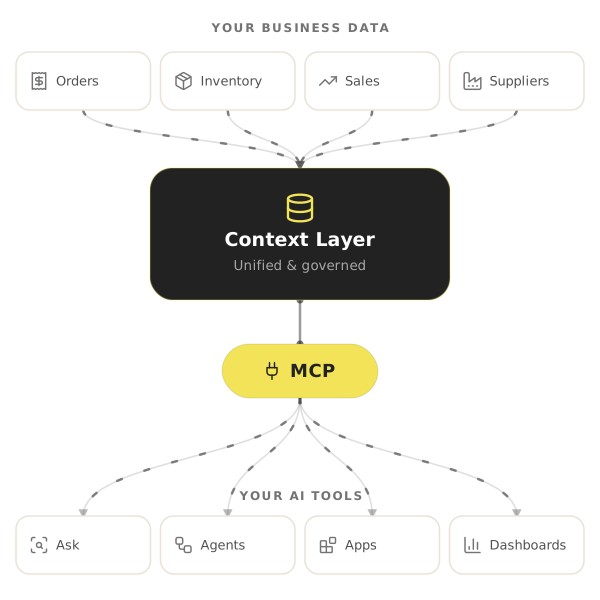
In short: MCP, the Model Context Protocol, is an open standard for connecting AI tools to data and systems. People often describe it as "USB-C for AI": one consistent way for any AI agent or assistant to plug into your business and securely read the context it needs. For CPG brands, MCP is what lets AI tools like Claude and ChatGPT work directly with your orders, inventory, and sales data instead of guessing.
What is MCP?
The Model Context Protocol is an open standard, originally introduced by Anthropic, that defines how AI applications connect to external data sources and tools. Before MCP, every AI tool needed a bespoke integration for every system it wanted to reach. MCP replaces that with one common protocol.
An MCP server exposes data and capabilities (for example, "read sales orders" or "look up stock on hand"). An MCP client (an AI tool like Claude, ChatGPT, or Cursor) connects to that server and can securely call those capabilities when it needs them. Because the protocol is standard, any client can talk to any server.
The analogy people use is USB-C for AI: before, every device needed its own cable; now there's one connector that works everywhere.
Why MCP matters for CPG brands
CPG brands run on a sprawl of systems: an ERP, one or more 3PLs, Shopify, Amazon Seller Central, retailer data portals, a forecasting tool, BI. The data exists, but it's siloed, and AI tools can't see it.
Without a standard like MCP, putting AI to work means building and maintaining a custom connector for every tool-to-system pairing. That's the N×M integration problem: five AI tools and six systems is thirty brittle integrations.
MCP collapses that. Expose your business over MCP once, and any MCP-compatible AI tool can read it: today's tools and the ones that don't exist yet. You're not betting on a single vendor's assistant; you're making your data legible to the whole ecosystem.
What AI can do with your data over MCP
Once your operations are exposed over MCP, AI tools can do real work against live data, not stale exports:
- Answer questions in plain English such as "which SKUs will stock out before the next delivery lands?" by reading current inventory across every warehouse.
- Monitor retailer availability across your retailer portals and flag out-of-stocks before they cost you sales.
- Rebuild forecasts against live sell-through instead of last quarter's assumptions.
- Reconcile Amazon and retailer settlement reports line by line.
- Trigger actions in your systems when you grant permission, whether that's creating orders, updating records, or flagging exceptions.
The AI brings the reasoning; MCP brings the secure, standard access to your reality.
Is MCP secure?
MCP itself is just a protocol, so security depends on how the server is built. A well-designed MCP layer for a business should provide:
- Access control. Granular permissions over who, and which tools, can see or do what.
- Auditability. A full log of every query and action, so nothing happens invisibly.
- Governance. A single place to manage what's exposed, instead of credentials scattered across a dozen one-off integrations.
This is exactly why most brands shouldn't hand-roll their own MCP servers against raw production systems. The protocol is the easy part; doing it securely and with correct business meaning is the hard part.
How to expose your CPG data over MCP
There are two broad paths:
- Build it yourself. Stand up MCP servers against each of your systems, normalize the data, and implement permissions and audit logging. Powerful, but it's a real engineering project to build and an ongoing one to maintain as systems change.
- Use a context layer. A context layer connects to your systems, unifies the data into one consistent model, and serves it over MCP with governance built in, so there's no per-system MCP engineering required.
For most brands, the second path is the difference between an AI strategy that ships in weeks and one that becomes a perpetual internal project.
How Corvera uses MCP
Corvera is the context layer for AI-native CPG brands. It connects to the systems you already use (NetSuite, Cin7, Unleashed, Shopify, Amazon, Snowflake, and more), unifies them into one governed source of truth, and serves that to any AI tool over MCP. You bring your preferred AI agents and assistants; Corvera is the shared, secure context they read from. Every query and action is access-controlled and audit-logged by default.
Frequently asked questions
What does MCP stand for?
MCP stands for Model Context Protocol, an open standard for connecting AI tools to data and systems.
Do I need MCP to use AI in my brand?
Not strictly, but without a standard like MCP you're back to building a custom integration for every tool. MCP is what makes AI access to your data scalable and tool-agnostic.
Can any AI tool use MCP?
Any MCP-compatible client can. Support is now broad across major AI assistants and developer tools, and growing quickly.
Is exposing my data over MCP safe?
It's as safe as the layer serving it. A governed context layer adds access control and full audit logging, so AI only ever sees what you allow, and you can see everything it did.
Curious what your operations look like exposed to AI over MCP? Book a 30-minute walkthrough and we'll map it against your stack.